Apart from having cancer in the first place, the cancer experience felt like my worst nightmare. In fact, it was my worst nightmare. Shortly after my diagnosis, I quickly realised that cancer is LOUD. It felt like the cruellest diagnosis for a highly sensitive, overthinking, introvert like me.
As a society, we’ve collectively decided that cancer is a disease to FIGHT and BATTLE in F U CANCER t-shirts. We made it an extroverted thing to do. My tumours were aggressive, but I was going to fight them in my epic battle with cancer that I would do in a bright red wig while raising awareness for my plight. Maybe that works for some people, but just reading that makes me wince. No other disease comes with people expecting an accompanying personality transplant.
Here’s a quick rundown of life as an introvert vs. life with cancer:
| Life as an introvert*: | Life with cancer: |
|---|---|
| Seek solitude to recharge | Constantly surrounded by help, alternating between not wanting solitude as time on your own is torture but needing solitude to feel like yourself again |
| Feel and process more emotions | BIG feelings, all the time, about everything, including but not limited to guilt, anger, fear, resentment, grief, pain… the list goes on |
| Are more prone to anxiety | Told you have a life-threatening illness and the treatment, if successful, can cause serious long-term side effects |
| Are more sensitive to external stimuli and need more time to process novelty | A bombardment of external stimuli with barely time to breathe before the next stop on the rollercoaster |
| Are more comfortable in smaller groups of people | Sitting in busy hospital waiting rooms and discussing intimate medical details in front of the entire chemo ward |
| Have a tendency for deep analysis, hence they need more time to process outside input | Presented with your own mortality on a regular basis, with no time at all to process what’s going on |
| Prefer to work independently | Independence gone |
| Value privacy and don’t openly share information about themselves | Life becomes kind of public |
Here are the five areas where I felt my cancer and introversion clash the most…
Overwhelming overstimulation
I played a game in a museum once where there were several lights on a wall. When a light came on you had to hit it as fast as you could, to put it out before the next one came on. It was a bit like this.
I like to imagine each light representing an area of life, say work, health, relationships, friendships, finances etc. In normal times, an area might need some more attention (there’s a new project happening at work), so the ‘work light’ goes on, you give it the attention it needs, the light turns off and you continue:
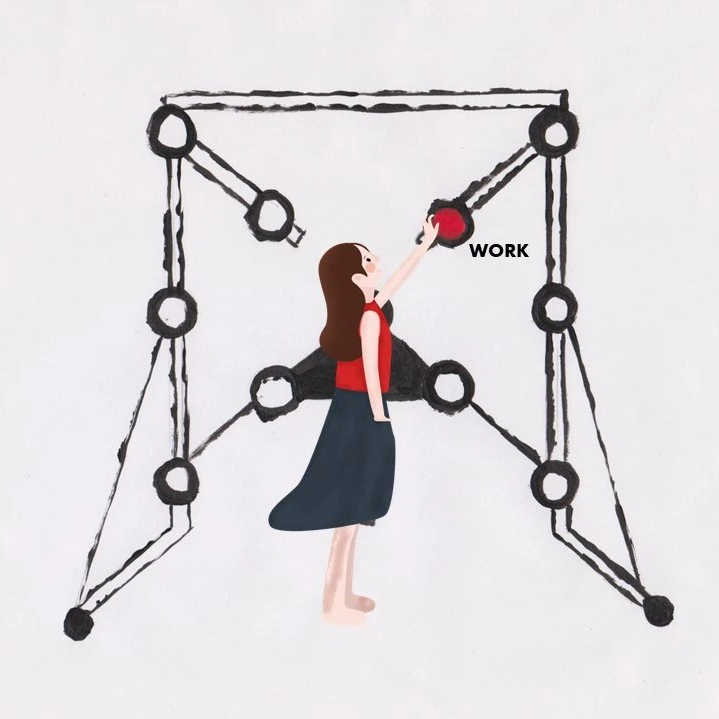
In mere days after my cancer diagnosis, all the lights started going off at once. My health was in freefall, I needed to move flats, I’d just started a new job, I was being bombarded with scary medical information left, right and centre, and surrounded by more people than I had been since pre-pandemic. Some lights (especially the health ones) kept flashing and beeping louder and louder. I couldn’t possibly attend to them all, but since I was also shocked, exhausted, and drugged, I had no space or time to deal with them anyway.
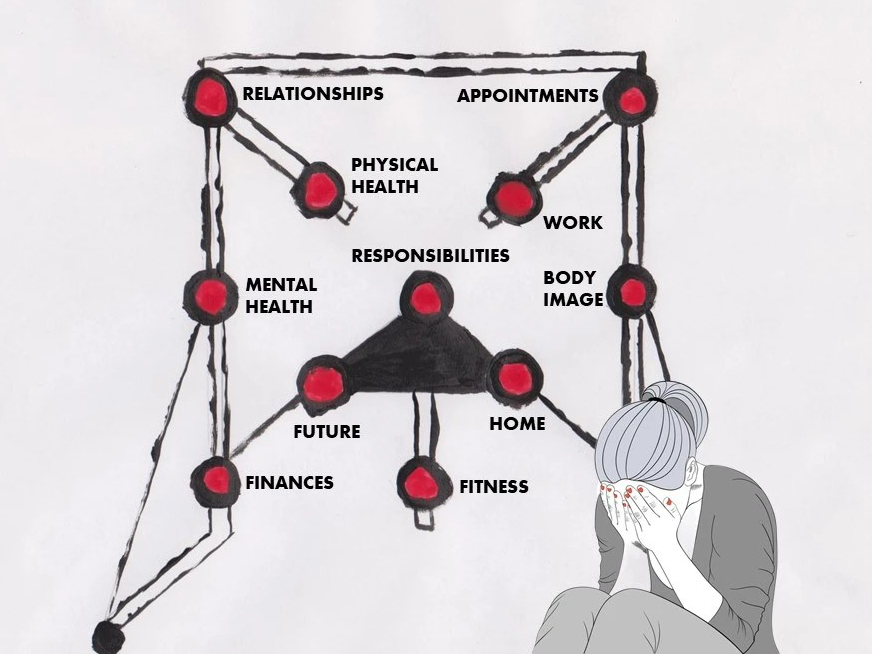
It’s completely overwhelming for everyone, not just the introverts who are more prone to overwhelm in the first place. A month or so into my ride on the cancer rollercoaster, I realised I was completely overstimulated. Those initial weeks were a complete assault on my senses, which promptly overloaded and shut down. I needed physical space and quiet to recharge away from it all, which is not a luxury afforded to those in the initial loops of the ride.
Spotlight
All the lights going off around me formed a combined glare that had me wincing in the spotlight. I’ve always hated being the centre of attention, but suddenly I was the only one in my peer group with cancer, the youngest on the cancer ward, the newbie at work with cancer, the one who everyone was concerned about. I didn’t like it. I felt like I was alone on a stage, hunched over and vulnerable, with everyone around me saying “we’ll take your lead Laura.” I’d stare back incredulously; I hadn’t chosen to lead this unwanted journey, so had no clue what was happening or where I was going.
Privacy
I’d been living my life quite happily when all aspects of it were suddenly invaded by cancer. I was grateful for people doing shopping, but annoyed when they queried why I bought a certain brand or why the inside of my cupboards were arranged a certain way. The seats and mirrors were adjusted in my car, the crockery arranged differently in my drawer, new names assigned to my work projects, new routines semi-established and drugs controlled each day. I wasn’t sure what was mine anymore – certainly not my life anyway.
At the start I felt incredibly private and protective of my diagnosis. I felt guilty for not replying to people, but I had to conserve strength to keep going and couldn’t lose it spending time repeating what was happening to me. Plus telling people felt like reliving the trauma of it all – a trauma I couldn’t yet accept as real. I dreamt of waking up from the nightmare, but it intensified so I fiercely guarded my story, preserving the Laura I was for a little while longer.
Further down the line, cancer began to feel quite public. People are sorry to hear about a broken bone but aren’t bothered about the details of your appointments. Cancer seems to make loose acquaintances feel entitled to an all-access pass to your insides and incessant updates. I found people’s fascination with my hair loss excruciating and unsolicited advice to be, well, unsolicited. I was on high doses of steroids that caused all sorts of mood swings, so it was also hard to know which annoyances were rational, but when cancer infiltrates all areas of your life, privacy evades you.
Other people
Very quickly I was lucky to have a hubbub of friends and family rallying round to help. This was amazing, but in those initial weeks I wanted to scream “back off for a month, I need to process what just happened!”. I wanted to answer the loud cries of “how can I help?” with “LEAVE ME ALONE”. Of course, I didn’t really want that, I needed everyone. But with everything else going on, the outpouring of love was overwhelming in its own way.
It came hand in hand with a loss of independence that left me grieving my old life; the one where I did what I wanted, when I wanted, however I wanted. Where I swam in a lake because I could, and spontaneously visited a friend on a weekend because I wasn’t worried about being too far from a hospital or struggling with side effects while driving somewhere alone. I constantly felt the push-pull of wanting everyone around and my introversion needing to breathe.
In lockdown someone sent me this card:

When you have cancer, you reach the end of your tether pretty quickly. And this is when, especially for introverts, you need to rely on other people more than ever before. They can’t do the treatment for you, but they can make phone calls, take you to appointments, translate medical news, research what you need, cook, clean, provide moral support and cheer you on. Once I’d dug as deep as I could, I realised I was taking strength from others, or rather they were giving it to me.
During the first week of the hurricane, I could feel Dad squeezing my hand on the way into all the appointments, willing his strength into me. During treatment, I was plied with nutritious food from Mum and bunches of flowers and gifts from friends which said, “keep going, we’re thinking of you all the time”. Kim and Mike were there throughout, going above and beyond to pick up the pieces when I couldn’t, and countless other friends and family members supported me.
The protective bubble of love and support that formed around me was truly incredible, I felt so loved and cared for. Looking back I see how people rooting for me gave me strength, even if I didn’t see that at the time. If you’re an introvert, try and embrace this support as much as you’re able to (you’ll miss it when it’s gone). The people providing it will keep you going – they are the extension to the end of your tether.
Decision making and phone calls
Introverts take time making decisions. I tend to weigh things up from all angles, talk things through with friends, and seek reassurance that I’m doing the right thing. Whilst still numb from the shock of a diagnosis, cancer patients are expected to make life altering decisions about treatment, deal with the aftershocks, maintain their actual life and absorb all the new information. It’s a lot.
I also hate the phone. I don’t know if that’s an introvert thing, but I’d take a punt that it is. Phone calls out of the blue feel intrusive and make me feel like a rabbit in headlights. It’s the bug bear of everyone around me that mine is always on silent. “But you won’t hear your phone ring” they say. Exactly, I think. If I do see a call, I regularly let them ring through then text back asking what they want.
Cancer comes with an onslaught of phone calls that require you to make decisions or process life-altering information on the spot. They are often from private or withheld numbers, so ignoring them is not an option. I’d start to feel tense about 9am, then relax(ish) a little after 5pm when the working day ended. Phone off! Sometimes I wanted it all to be over purely so I could put my phone on silent again.
I have no grand epiphanies for how to deal with all this – I’m still recovering from it all myself. That’s the thing with a shock diagnosis: the challenges all come at once, unexpectedly. One day you’re ticking along, one fateful scan later your whole life is overhauled. I hadn’t accounted for my frazzled nerves, the emotional load, the adrenaline, the waiting, spending time in a hospital, learning to be a nurse, a logistics manager, administer injections, take care of a wig, manage side effects, keep on top of appointments, deal with the total upheaval, the changes in work, changes in body image, becoming dependent on others and general lack of any kind of processing time.
So maybe it helps to know that while you’re tired because of the cancer and the treatment and the logistics, you’re also tired because you need time to recharge and that time just isn’t there right now. If you prefer calm, minimally stimulating environments, the cancer rollercoaster is anything but. So give yourself permission to recharge as much as you can between appointments. Remember that it’s okay to quietly dump the lumps without all the accompanying fanfare, and tell people as little or as much as you want.
Overwhelm comes with the territory, but you can learn to take strength from others and accept their help, even when you want to hide away in a darkened room. Remember that the qualities that make this hard for you are the qualities that make you wonderful – you’re not too much, but this is too much for you. One day your introverted compassion, observation skills, creativity, empathy, and quiet perseverance might be just the traits needed to help you, and others, to recover. You’re not alone in this and that is a wonderful thing, even for an introvert.
 Laura writes...