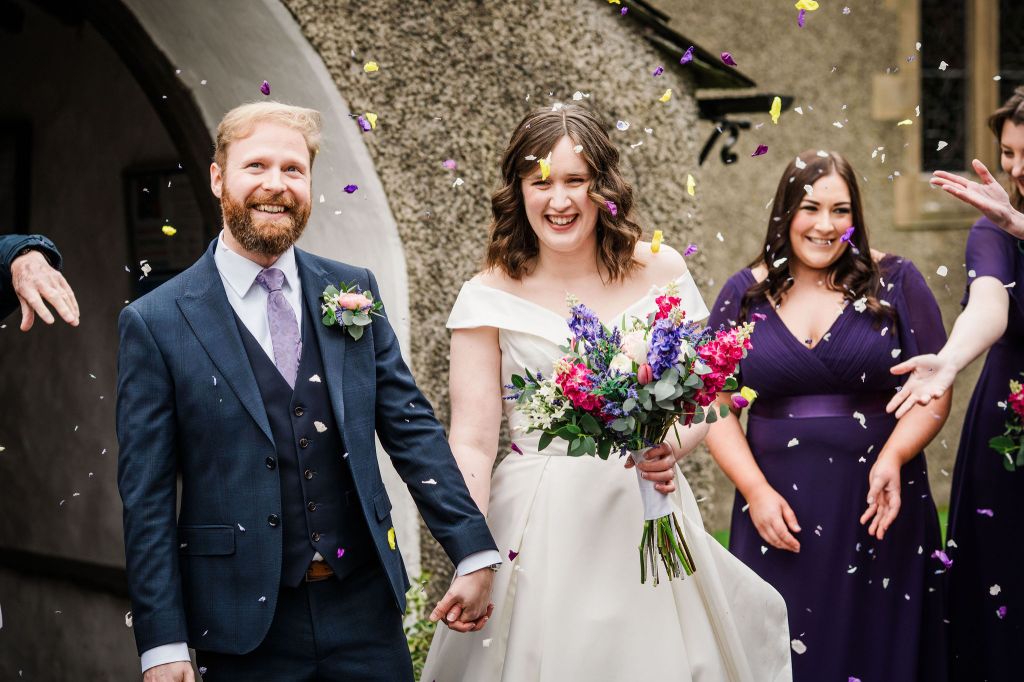
We had a wonderful wedding in March 2025, and now that the photos are printed, the thank you cards sent, and the dress dry cleaned, I thought it was time to reflect on the whirlwind that is wedding planning.
We got engaged almost exactly a year earlier, in March 2024. Back then, I’d have told you that a year was aaaggges to plan a wedding, and in some ways, it is. But once we started looking at options, we quickly realised we wanted something small and personal. I fell in love with a historic National Trust house tucked into the hillside in Grasmere, along with the beautiful church nearby, and, just like that, we were thrown headfirst into the world of DIY wedding planning.
For context: going DIY basically means we didn’t book a venue that handled everything for us. We had complete creative freedom, but also full responsibility for the food, furniture, décor, timings, cutlery, logistics, and every tiny detail in between. It was way more than I’d anticipated, but I have no regrets. We had the wedding we wanted, and I learnt a lot along the way.
So, here goes…
An engagement is a portal to a whole new world…
…and it was a lovely world to step into. I think part of why chemo sucked so much (beyond the obvious reasons) was that none of my friends had been through it. It felt wonderful to be doing normal 30-something-year-old things again and hitting milestones at the same time as everyone else.
I didn’t know anything about the wedding industry but quickly discovered a whole new ecosystem — people with jobs I didn’t know existed, details I’d never thought to consider. The sheer number of people involved in a wedding (and also cancer treatment) is an astonishingly beautiful (and somewhat stressful) thing. From the start of both weddings and cancer treatment, you’re buoyed along by what Joseph Campbell called “a thousand unseen helping hands.”
Expectations tug at your ankles without you even realising
You know that feeling when you’re standing with your toes in the sea as the tide’s going out? You feel like you’re standing still, but there’s also this strange sensation that you’re being pulled by a force that you might not even notice if you’re looking up at the sky.
Very quickly, that can become what wedding planning feels like.
A wedding is not the same as a 30th birthday party. You can do whatever you want for a birthday and nobody really minds. But with a wedding, you’re suddenly hit (consciously or unconsciously) with generational expectations, family opinions, comparisons, and the way things are done. (Plus, all the thoughts you’ve ever had about your potential future wedding.) These expectations run DEEP and can tug you in one direction or another before you even realise what’s happening.
Do whatever YOU want to do
A funny thing happens when you get engaged. At first (when all the expectations are still invisible) the message you hear most often is:
“This is your day. Do whatever YOU want to do!”
Then, a little further down the line, that shifts to:
“This is your day, do whatever you want to do, but… have you considered?”
Which slowly becomes:
“This is your day, but have you thought about this potential problem?”
And eventually turns into:
“We are really concerned about this aspect of the day…”
Weddings highlight every single friend and family dynamic you have
This one was especially tricky for a first-born, people-pleasing, peacekeeper like me. Unless you’re having a wedding with unlimited guest numbers (which isn’t within 99.9% of budgets), the uncomfortable truth is this: you’re forced to take an inventory of all the relationships in your life, then put them into a hierarchy that will be on full public display.
- Is that a ceremony-only invite or an all-day invite?
- If X comes, then surely Y has to come too, because they’re part of the same group.
- If this person’s there, they definitely can’t sit next to that person.
- Do plus-ones you barely know come above colleagues you see daily?
- Are we inviting all extended family or is there a line? Is there a line?
- If I went to their wedding, does that mean they have to come to mine?
- Are we having kids at the wedding? Or just family kids? Or no kids at all?
- Would I usually pay for dinner for this person? (Would I even want to?)
The list goes on… So yes, do whatever you want to do — but, um, also… I just wondered if Great Aunt Susan is invited?
“The only thing that really matters is…”
Around the same time as you’re becoming deeply entrenched in wedding planning — deciding what you want to do, being hit with excited questions and opinions, wondering how on earth it will all come together — people turn to you and say, “At the end of the day, as long as the two of you get married, that’s all that really matters.”
And to that I say… yes, but also no.
Because if you’ve chosen to have a wedding with actual, real-life guests, then those guests — who’ve likely taken time off work, travelled, booked accommodation, bought outfits, maybe even arranged childcare — need to be fed and entertained. You want them to enjoy themselves too.
Something tells me that if you walked out of the church or registry office and said, “Well, the only bit that matters is done, so… that’s it! We’re off on our honeymoon! Bye!”, people might feel a little put out.
So yes, getting married is the reason you’re doing this in the first place (a surprisingly easy thing to forget when you’re knee-deep in seating plans), but what happens for the rest of the day matters too — it’s what makes the day yours. (And if you don’t decide how to spend the rest of the day, then somebody else will.)
A wedding is a living, breathing organism. Once created, it takes on a life of its own.
The moment the wedding train gathers steam, it’s very hard to slow it down.
It’s wild how quickly you go from “I have no idea how to plan a wedding”, to googling:
“How many toilets are required for 40 guests?”
“Is confetti allowed in a National park?”
“What kind of British flowers are available in winter? Will they look good in a buttonhole?”
Suddenly, the whole thing has so many moving parts and logistical demands, it’s a wonder anyone manages to pull it off while holding down a job, maintaining a social life, and vaguely looking after themselves.
It’s an extension of you — but it’s not you. It’s bigger than you, which makes it very easy for it to grow arms and legs and run away.
DIY wedding planning is a crash course in project management
Planning a DIY wedding must surely be the equivalent of a Masters in Project Management. At times, it felt like I was back at uni, working on a year-long dissertation slowly building to one big deadline. Only this time I was budgeting, planning decorations, and coordinating suppliers and guests. Our wedmin included a hair and makeup artist, photographer, florist, musicians, taxis, caterer, seamstress, crockery supplier, furniture hire company, venue staff, day-of coordinator, and — over at the church — a fantastic warden, vicar, organist, and secretary. Oh, and 40 guests. Plus a few extras just for the ceremony.
I once heard that wedding planning should only take up one evening a week. That might be true if your venue does everything. But with a DIY wedding, especially in the final stretch, it becomes a part-time job on top of your full-time one, involving logistics, timeline planning, people management, creative direction, supplier coordination, and a whole lot of problem-solving under pressure. By the end, you’ve gained a fount of oddly specific knowledge and a much deeper appreciation for what it takes to bring an event to life.
Phew, we may be in the thick of it now, but we’re only just getting started! Click here for Part 2…
 Laura writes...
One thought on “Everything I learnt whilst DIY wedding planning (part 1)”